
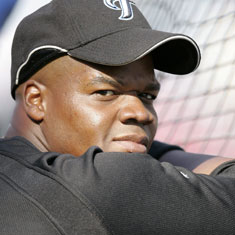
 With Carlos Delgado looking like he’s more ready for an oldtimer’s game than a big league contest, and Frank Thomas recently released by the Toronto Blue Jays, no doubt there are some people wondering if the Mets will consider picking up the “Big Hurt”.
While I have been a Frank Thomas since the late 1980s — I followed his (and Bo Jackson’s) college career at Auburn through the pages of Baseball America — signing him now, at this point in his career, makes little sense for the Mets, for several reasons.
First of all, Thomas was released because he was unhappy with his new role as a bench player. Throughout his career, Frank Thomas has been a star, and an everyday player. He still believes he can help a team in a regular role. That type of role is unavailable to him in a Mets uniform right now. Yes, Delgado is stinking up the joint and his bat speed can be clocked by a sun dial, but Omar Minaya and Willie Randolph will stick by him for at least a few more weeks before acknowledging that Carlos is washed up. If Thomas is unhappy riding the pine in Toronto, why would he agree to be a backup in New York?
Secondly, even if Thomas is amenable to being a bench player for the Mets, there’s no guarantee he’d flourish in such a role. He’s never come off the bench before, and the ability to do so is greatly underrated. It took several years for Marlon Anderson and Damion Easley to learn how to be at the ready and perform well in a limited role, and to expect Frank Thomas to suddenly turn into a viable pinch-hitter is asking too much.
Thirdly, Frank Thomas is a guy who — at this point — is a one-dimensional player: he hits mistakes over the fence, and doesn’t do much else. He can’t run the bases, he can’t field well, and doesn’t hit for the high average of yesteryear (actually, he sounds a heckuva lot like Delgado right now). He might take more pitches and draw a few more walks, but that doesn’t help much being a station-to-station baserunner. To be valuable to a team, Thomas has to get enough at-bats to keep his long swing in rhythm to take advantage of those mistakes. He won’t be the kind of guy who can play twice a week and hit 20 HRs in 300 ABs — he’ll need at least 500 at-bats to get the ball over the fence often enough to justify his existence. That likely won’t happen in a Mets uniform.
Oh, and the other reason he’s still able to hit mistakes is because he has nearly 20 years of experience batting — in the American League. He’s seen plenty of veteran pitchers many times over, and takes advantage of elephant-like memory to occasionally guess right on what pitch is coming next. By moving to the NL, he would face many pitchers for the first time, and not have the benefit of previous experience. It’s common for longtime veteran hitters to be stymied when switching leagues (i.e., Roberto Alomar).
Finally, do we even know if he can play the field any more? The last time he wore a first baseman’s glove was 2004, and that was before his nasty foot injury. He’s a gifted athlete, for sure, but hasn’t fielded a ground ball in four years, might be less mobile than Carlos Delgado (if that’s possible), and is over 40 years old.
Maybe, if we knew Frank Thomas could play the field adequately — at least as well (?) as Delgado does now — AND we knew he still had bat speed, he might be worth considering. But unfortunately, thinking of him as the Mets’ answer to their first base problem is akin to forcing a square peg into a round hole.
 The Mets are in Wrigleyville for a two-game set, playing the 2007 NL Central Champion Chicago Cubs.
 Lately, I’ve been listening to parts of the Mets broadcasts on radio, for whatever reason. Last year, I thought Howie Rose and Tom McCarthy sounded too much alike — I couldn’t tell which was which at times. But, it wasn’t a big deal — they both sounded fine to my ears and did a nice job of describing the game.