
Oliver Perez: Pitch Now, Talk Later

The big news from Port St. Lucie is that Oliver Perez received a “stern talking to” from ace pitcher Johan Santana, presumably to motivate the erstwhile and enigmatic lefthander. This comes only a day after pitching coach Dan Warthen publicly lambasted Perez for being “out of shape”. From Steve Popper’s blog:

Warthen said that Perez got out of shape and underworked while pitching for the Mexican squad in the World Baseball Classic, not even mentioning that when he did pitch he posted a 9.45 ERA in his two games. The real problem is that Warthen said he came back to camp out of shape.

“Even though the weight is about the same as the end of last year he is still not the same guy we saw, the energetic guy,” Warthen said. “Even the life around the clubhouse is not the same.”

Huh … when was the last time you heard an MLB pitching coach — from any team — calling out one of his players in the media? Kind of a strange, if you ask me. (Though, right in line with the Jerry Manuel course “Motivating Men Through the Media 101”, which grew tired in Chicago.)

This most recent report about Santana speaking to Perez is equally strange. Why was it made public? Is it the Mets’ answer to criticism that their clubhouse is leaderless?

In any case, I find the timing incorrect. Opening Day is nine days away, and I don’t know how Oliver Perez is going to “get in shape” so quickly. But more importantly, the Mets — and Santana — are missing the mark by kicking Ollie when he’s down. Oliver Perez is most vulnerable not when he’s doing poorly, but when he’s successful.

Ollie is a unique talent, to say the least. His mechanics have too many moving parts and can quickly fall out of sync, often to disastrous results. If we’ve learned anything from three years of his rollercoaster ride, it’s that he can, and will, eventually get going, but can just as quickly fall. In fact, his biggest problem is that when he is pitching well, his confidence surges to the point where he thinks he can do things he shouldn’t be doing (I believe Rick Peterson called it “freelancing” or something similar).

That understood, the time for a pep talk is not now, but when he’s doing well. When Ollie strings together two or three great outings, THAT’s when Johan Santana should sit Perez down and remind him stay focused, and to continue to do all things that are making him successful — and not be a “cowboy”.

After seeing Perez throw in the most recently televised spring training game, I actually thought he did well. The results were not good, but the process was — and in the spring, it is the process that matters. Ollie returned to the step-straight-back movement behind the rubber, which initiated a straight movement toward home plate. His momentum was gathered nicely and directed in a straight line at his target. Rarely did he fall off toward third base on his follow-through. Those are good signs. His velocity wasn’t great, but I believe that was more the result of concentrating on keeping his mechanics in line than anything else — thought slows you down. His command was off, and that was due to an inconsistent release point, which was due to the mechanical changes — for the last three weeks he’s been throwing in a way that his body is falling away from that straight line, and as a result, his release point is in a different spot. It takes time and repetition (not outside criticism and pep talks) to “get back” what was lost.
Posted in Latest Post, Pitching Mechanics, Pitching Staff, Spring Training 2009 | Tagged , , | 7 Comments

2009 Fantasy Projections – First Base

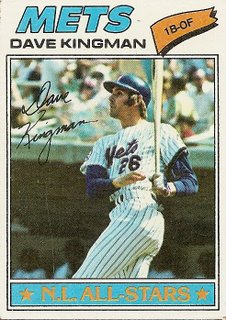
Kingman was doing dual position eligibility before it was fashionable

Kingman was doing dual position eligibility before it was fashionable

My name is John and I regret nothing… Except for that last burrito.

When last we met, I was telling you that Ramon Castro was worth a buck and Ronny Paulino might be working in a car wash by mid-August. Only time will tell…

First Base Rankings

If you’re not getting Pujols, try to grab Gonzalez on the cheap. I think you’ll be overpaying for Howard, Berkman and Fielder, in most cases. Let me explain…

Albert Pujols (.320-35-120) – One of the few positions where there is no doubt about who is the best offensive player.

Ryan Howard (.250-40-120) – His BA leaves alot to be desired, but I think it may be higher. You can’t argue with his HR/RBI totals.

Adrian Gonzalez (.300-30-100) – The most underrated of this bunch. His HR/RBI totals have increased each of the past 3 seasons and he has hit around .279 or above in each of those years. If he brings his Petco numbers up (only .269 last season), he could challenge Howard for the #2 spot.

Lance Berkman (.310-25-95) – I’ve been waiting for Berkman to fall off for a couple of years – his HR totals have fallen three consecutive years but he’s still a solid pick. Houston’s lineup could hold down his RBI totals

Prince Fielder (.275-28-100) – People are still drafting Fielder with hopes that he will return to the 50 HR slugger he was in 2007. I think those numbers will prove to be a statistical outlier. You can count on Fielder for something in the .280-30-100 ballpark for years to come. In future drafts, he may be a steal at those numbers, but not this season.

Sleeper – James Loney (.310-18-100) – I absolutely love watching Loney hit. I’m not sure if he’ll ever be more than a 20HR guy, but he drives the ball well into the gaps and he is only 24. The Dodgers lineup could provide plenty of RBI opportunities, depending on Manny’s willingness to play and Torre’s willingness to put Loney into the #5 hole. If it all comes together for him, this could be his breakout season.

NL East

A much better crop of players than we saw in the NL East catcher rankings… However, two of my top five guys will start the season at different positions.

Ryan Howard (.250-40-120) – See above

Adam Dunn (.240-40-100) – I expect him to gain 1B eligibility in most leagues at some point. If you need another 1B to cover for him, take a shot on a guy like James Loney or even Nick Johnson.

Carlos Delgado (.260-30-100) – People were calling for Delgado to be cut in May 2008. By the end of the year, he was on fire. He’s still got some pop, but he’s old and he has lost batspeed. He could end up outperforming Ryan Howard or falling out of the top 5 in the NL East… I think his HR/RBI numbers will be fine, somewhere between ’07 and ’08. Get him if he falls on draft day.

Jorge Cantu (.275-25-90) – Another guy who should wind up playing 1B before too long. I’m not sold on him repeating last season’s numbers – and those numbers don’t make him a good choice at 1B, but if you get him late he could end up being a nice reserve player with dual position eligibility.

Sleeper: Nick Johnson (.280-10-65) – If Johnson stays healthy (unlikely), he could have a nice season, but he’s hardly worth considering in anything other than a deep NL-only league. He plays the game the right way and that should count for something, but it doesn’t. Oh well.

Posted in Predictions | Tagged , , , , , , , , , | 2 Comments

2009 Fantasy Projections – Catcher

Gary Carter: He won't get injured and his BA won't hurt your team

Hi. My name is John. I enjoy eating pizza and yelling at parked cars.

Joe asked me to step in here and write something, so here goes… I’m going to rank the top 5 players at each position in the NL and the top 5 in the NL East. These offensive rankings are both for the season and for fantasy baseball – because that’s just how I roll.

Today’s position is catcher. Here goes:

National League Catchers

Catchers… Always a crapshoot and usually a big disappointment if you draft them too high. My strategy is to draft Gary Carter and live in a nostalgic fantasy world while everyone else’s catchers are on the DL or batting .220 due to sprained fingers and bad knees. When in doubt, think about ’86. Bring on the rankings:

  1. Brian McCann (.295-22-95) – If he stays healthy, the numbers could be even better.
  2. Russell Martin (.290-15-75) – Solid hitter without much power. If Torre doesn’t run him, his overall value could drop significantly in mixed leagues, but he has been durable and should drop no lower than the #2 catcher in the NL.
  3. Ryan Doumit (.310-18-75) – This guy can flat out hit but he’s an injury risk.
  4. Chris Iannetta (.260-20-85) – A decent prospect who finally came through last season. He should continue to improve and you can’t really go wrong with a catcher who calls Coors Field home.
  5. Ivan Rodriguez (.275-14-60) – I don’t believe in Geovany Soto (yet) and I’m willing to bet Pudge has enough in the gas tank for one more decent season. It looks like he may be hitting second, which could improve SB totals (he had 10 last year). Steroids or not, the guy knows how to play the game and he could be one of a few bright spots in Houston this season, until he is traded.

Sleeper: Keep an eye on Pablo Sandoval. He has an undisciplined approach at the plate, but he should get ABs and he should have or attain 1B/3B/C eligibility in most fantasy leagues.

National League East Catchers

After Brian McCann, things fall off sharply. If you take any other NL East catchers in your fantasy draft, you should probably just forget about your team, because you’re in serious trouble. There’s always fantasy NASCAR…

  1. Brian McCann (.295-22-95) – If he stays healthy, the numbers could be even better.
  2. John Baker (.250-12-65) – I like Baker’s approach at the plate and he may benefit from hitting in a decent lineup (if Florida’s lineup doesn’t regress). Get him cheap and hope for the best.
  3. Jesus Flores (.240-12-65) – Flores may be overrated because his name isn’t Paul LoDuca. I like him if he comes cheap.
  4. Ramon Castro (.250-7-35) – I can’t put Brian Schneider on this list. I just can’t. At least Castro has some upside – I could see him posting line of a .260-10-60 if he gets the chance to play everyday for extended time. If you’re in a deep NL-only league, Castro for $1 might pay dividends. Or not. Hey, it’s only a buck.
  5. Carlos Ruiz (.240-6-40) – Eh. I think Ruiz loses his job by mid-season, if Ronny Paulino shows up to play. If not, the Phillies could trade for a competent catcher (Ivan Rodriguez?).

Sleeper: Keep an eye on Ronny Paulino. He could be out of baseball and working in a car wash by mid-August, but he could also be hitting .270-8-55 by then too.

UPDATE: 3/26/09 – I have updated Ramon Castro’s projection. Thanks to Isuzudude for pointing out my projection was incorrect based on probable playing time.

Posted in Predictions | Tagged , , , , , , , | 5 Comments

Why K-Rod and Putz Might Not Matter

Ask anyone why the Mets finished in second place last year and the immediate answer is “the bullpen stunk”. People are quick to point out the 29 blown saves as evidence supporting that claim. Also buying into that theory was the Mets’ front office, who sought to band-aid the problem by acquiring the AL West’s two best closers. Problem solved, right?

Not so fast. Before we assume that J.J. Putz and Francisco Rodriguez slamming the door on innings 8 and 9 are the “final ingredient” for the Mets’ entry into the postseason, let’s continue to follow the data.

Blown Saves: Putz and K-Rod


Question: who blew more saves last year, J.J. Putz or Billy Wagner?

Answer: You may be surprised to find out that Putz blew 8 games, to Wagner’s 7. But Putz was injured in 2008, so we’re willing to give him a pass. Right?

Question: who blew more saves last year, Francisco Rodriguez or Aaron Heilman?
Answer: K-Rod, who blew 7 to Heilman’s 5.
Granted, K-Rod converted 89.8% of his save opportunities, finishing with 62.

But still, 7 blown saves is 7 blown saves. Add Putz’s 8, and the Mets acquired 15 blown saves this offseason — more than half of the 29 they blew in 2008.

Fans will find out quickly that despite their skills, Putz and K-Rod are not “automatic”. In fact, of K-Rod’s 68 innings pitched last year, he went one-two-three only 22 times (FYI, the Royals’ Joakim Soria led all of MLB with 36 “clean” innings). Also of note: K-Rod never pitched more than one full inning in 2008.

Breaking Down the Mets’ 29 Blown Saves

A few numbers to consider regarding the 29 blown saves that supposedly ruined the Mets season:

9: the number of games that were WON by the Mets, in games they blew a save
13: the number of blown saves that came after Billy Wagner went on the DL
11: the number of blown saves that occurred BEFORE THE 8th INNING

That last number is most intriguing. Many people don’t realize that a pitcher can be assigned a blown save as early as the 6th inning. The big deal about getting Putz and K-Rod is that the Mets can now “shorten the game” to 7 innings. However, the Mets will still have to find a way to bridge the gap in the 6th and 7th, a time when more than one-third of their blown saves occurred.

Subtract those 11 “early blown saves” from the 29, and you’re down to 18 blown saves. Subtract the 9 games that were won, and you’re down to 9 blown saves that occurred in the 8th or 9th inning, that resulted in a loss.

Suddenly, the Mets’ bullpen doesn’t look so awful, does it? Now, consider again that Putz and Rodriguez combined for 15 blown saves last year, and ALL of their blown saves occurred in either the 8th or 9th frames, and you tell me whether the bullpen is definitely improved over last year.

Posted in Latest Post, Pitching Staff | Tagged , , , , , | 6 Comments

Freddy Garcia Accepts Demotion

The New York Mets have assigned Freddy Garcia to minor league camp, and he’s accepted the decision.

The righthander has been struggling with the velocity and command of his fastball, and has been lit up by every team he’s faced this spring — including college hitters in a brutal 1/3 inning against the University of Michigan (oops, that was Tim Redding … they all look the same to me in the boxscore!).

Mets Assistant GM John Ricco said that Garcia could stay in Port St. Lucie at the end of spring training, or be sent to Buffalo.

While it’s too bad that Freddy hasn’t yet worked out, this remains a no-risk gamble for the Mets. As long as Garcia is not on the 40-man roster, he is paid only a minor league salary. If he builds himself back up and can find his way to the 40-man, then he’s owed $1.5M. I still believe he can be useful as a back-end starter if he can get his velocity up to the high 80s.

This announcement pretty much solidifies Livan Hernandez as the Mets’ #5 starter to begin the season. I wouldn’t be surprised if Livan finished the season as the team’s #3.

Posted in Latest Mets News, Spring Training 2009 | Tagged , | 2 Comments

Maine’s Stride Length Explained

We mentioned yesterday that Dan Warthen finally did some tinkering with John Maine’s mechanics, as we’ve been suggesting since last June.

One of the adjustments Warthen is making to Maine’s motion is lengthening the stride:

“He’s cutting himself off, landing too soon,” Warthen said. “In the back of his mind, he was afraid to let go.”

So Maine threw about 50 pitches Monday under Warthen’s intense observation. Maine lengthened the stride his front foot took by eight inches. Warthen seemed pleased with the results. “The ball was coming out of his hand very well,” he said. “Still a golden arm.”

Inquiring minds may want to know what that eight inches can really accomplish. In a nutshell, by lengthening a pitcher’s stride, you accomplish three thing:

1. Allow the arm to “catch up” to the body, and time the release closer to the hip rotation / explosion.
A pitcher who strides too short can end up opening his hips too soon, putting the brunt of the pitch’s velocity on the upper body / arm. Kinesiologists suggest that the the length of the stride should be about equal to the total arc of the throwing arm’s motion, starting from the break of the hands to the release point.

2. Increase the amount of force applied to the ball.
This could be partially explained by Newton’s Second Law of Motion (interestingly, if pitching coaches paid even slight attention to Newton, we’d have less pitching injuries). In short, by lengthening the stride you are also generating momentum and increasing the time that force is applied to the baseball. Think about it this way: if you were going to punch someone, would you start your jab at a few inches in front of your chest, or would you rear your fist back to your armpit before punching forward? The latter, of course, because the increased distance of your fist’s path results in more power generated to your opponent’s jaw (try this at your next bar fight). The same principle works when hurling a baseball.

3. Shorten the distance between the release point and home plate.

This is a no-brainer: by lengthening the stride, you also release the ball further away from the rubber, and decrease the distance the ball needs to go. Again, this is simple physics — by decreasing the distance, the batter has less time to react to the pitch — even if the velocity stays the same. This is why Randy Johnson has been so devastating on hitters — because of his height and long arms, his release point is about foot closer to the batter than any other pitcher; his 93 MPH may be perceived as closer to 96 MPH because he’s decreased the time (maybe some math nut can give me the correct numbers, but you get what I mean).

Now the million-dollar question: why doesn’t every pitcher increase his stride?

First of all, a pitching coach worth his salt will indeed lengthen a pitcher’s stride as long as possible, because of the three points above. However, there is a point where pushing more length will hinder rather than help — particularly with pitchers at the MLB level who have been throwing one way their entire lives. Everyone is unique, and everyone throws differently, and I believe biomechanics and kinesiology play a major role in determining the perfect stride length — but I’m not expert enough on either subject to speak intelligently.

In Maine’s case, Warthen apparently saw a shorter stride than Johnny had used prior to his shoulder injury, and it makes sense. As a pitching coach, the stride is one of the first indicators I implore my pitchers to check when they’re having issues — they need to stride the same distance and land in about the same spot every time to pitch consistently. I’d be interested to know if Maine was not only striding shorter, but if he’s striding straight. But that’s for another day.

Posted in Latest Post, Pitching Mechanics | Tagged , , | 4 Comments

Dan Warthen Reads MetsToday

Personally, I didn’t think Dan Warthen even knew how to turn on a computer, much less find his way to the internet to read a blog. But this recent article on Mets.com proves he’s paying attention to the blogosphere (hat tip to MT loyalist “sincekindergarten”). Specifically:

The more simplified delivery Warthen also implemented — with less rotation of the body — is “more repeatable,” in his words, and won’t be compromised so readily by extra effort put forth in moment of duress. Maine should have a smoother, more consistent delivery.

John Maine over-rotatingEmphasis on “… with less rotation of the body …” mine. I haven’t yet seen what is being described, but I’m guessing that Warthen is working on Maine’s over-rotation issue — which was pointed out on MetsToday as long ago as last June.

Again, I haven’t personally seen the adjustment made by Warthen, and not sure when he began adjusting Maine’s mechanics. The last time I saw Maine on TV was at least two weeks ago, and he was still carrying the ball and over-rotating. Part of the problem is that it will take many, many hours of correct repetition to correct the problem, so even if Warthen implemented the fix in February, we may not see the results until May or June. “Old habits die hard”, so the saying goes, and it is perfectly apt in the case of baseball mechanics.

Posted in Latest Post, Spring Training 2009 | Tagged , , | 6 Comments

Pros and Cons of Dan Murphy at Number Two

It’s official: Daniel Murphy will be the #2 hitter in the Mets’ lineup, according to manager Jerry Manuel. Furthermore, Luis Castillo will bat eighth.

Should we break out the Champagne now, or wait for October?

In all seriousness, Manuel did in fact anoint Murphy as his on-deck guy to start every game — only weeks after announcing that Murphy would NOT be platooning with Fernando Tatis, nor anyone else.

Per Manuel:

“I think the evolution of Murphy, that might be his best spot,” Manuel said. “Somewhere in the top. That type of guy, the way he swings the bat and puts the ball in play, you’d like to see him get as many shots as you could.”

Is this the best fit for Murphy, and the rest of the Mets’ personnel? On the one hand, it’s good to have a high OBP guy in the #2 spot, for obvious reasons — to set the table for the big boppers. On the other hand, will Murphy have a high OBP? Yes, he’s been tearing it up this spring, and posted a .397 OBP in his brief debut last year. But neither his 149 MLB plate appearances in 2008 nor his ability against out-of-shape AA pitchers are guarantees that he’ll continue to get on base 40% of the time. It’s true, he has shown patience and the ability to go deep into counts. But he’s taken pitches more to set up his own at-bat, rather than to give Jose Reyes a chance to steal. Will he take pitches down the middle so Jose can take second base? Should he?

Another question: can Daniel Murphy sacrifice bunt? I don’t believe I’ve seen him square around yet. Of course, the statheads will tell us that doesn’t matter, because the bunt is such a low-percentage play. OK, fine, but can he hit-and-run? Again, I don’t know, I haven’t seen him do it enough. In addition, he’s been more of an opposite-field hitter than a pull hitter, which means when he dumps singles into left, Jose Reyes likely will have to stop at second.

Before I condemn this announcement, I do have to admit there are many reasons it makes sense. The best reason is that by putting Luis Castillo in the eight hole, you have, in essence, a second leadoff guy at the bottom of the order. With the pitcher batting behind him, Castillo will likely draw more walks than at the #2 spot. If Castillo is on first, he’ll soon be on second, thanks either to him swiping the bag or by the pitcher bunting him over. Better yet, Castillo steals second and is bunted to third by the pitcher. In either case, Jose Reyes — who happens to be a strong hitter with runners on base — can be presented many RBI opportunities. In contrast, it’s doubtful that Brian Schneider (who likely would be #8 if Castillo were #2) would get on base and score as many runs as Castillo.

Oh, and there we have the other issue with this lineup plan: Schneider would most likely be batting seventh. Let’s get something out of the way: I love Brian Schneider the catcher. Brian Schneider the hitter? Not so much. Offensively, he’s average to below average for an MLB catcher in this day and age. He’s a typical #8 hitter, meaning, you want him to come to bat as few times as possible, because there are seven players who are better. Putting him #7 means he needs to do a little better than he did last year — and I’m not sure that’s possible.

Ah, but there’s another glaring observation: if Schneider is #8, that means Murphy is likely #7, Church #6, and Delgado #5. See a pattern? Four straight lefthanded hitters, making the Mets vulnerable to the LOOGY. Therein lies another good reason to put Murphy #2 and Castillo #8 — to cut that vulnerability down by at least one hitter. That is a huge deal, particularly since Fernando Tatis and Ramon Castro could be the only two RH hitters coming off the bench.

Everything depends on Murphy continuing to hit like he did in his first 30 games in MLB, and not like his last 20. Otherwise, that lineup could change quickly.

Posted in Latest Mets News, Spring Training 2009 | Tagged , , | 7 Comments