The Marcos Carvajal Mystery

Marcos Carvajal pitching for the Mets in spring trainingAt the beginning of spring training — February 16th, to be exact — the Mets quietly claimed righthanded pitcher Marcos Carvajal off waivers from the Tampa Bay Devil Rays. Steve Schmoll was dropped from the 40-man to make room for the 23-year-old fireballer.

Carvajal has been a nomad since signing his first pro contract with the Dodgers in 2002, getting traded four times and snapped up in the Rule 5 draft once before being waived away by the Rays. In addition to Tampa Bay, Los Angeles, and the Mets, he’s also been property of the Brewers, Mariners, and Rockies. In all that time, he’s spent one year in the Majors — 2005. As a 20-year-old for Colorado, he pitched in 39 games (all relief), posted an 0-2 record with a 5.09 ERA and 47 strikeouts in 53 innings. He also had one hit, a two-run single.

Sandwiched around 2005 were promising seasons in the minors, riding a fastball that is consistently in the mid-90s and nears triple-digits. As with most young flamethrowers, his control has been an issue; he’s walked 177 batters in 346 minor league innings.

The Mets assigned him to the AA Binghamton starting rotation to get lots of innings, hoping the volume would help him learn to command his electric stuff. The results were mixed, and less than impressive: 119 innings, 120 hits (including 13 homers), 63 walks, 92 strikeouts, and a 5.22 ERA. Those numbers hardly scream dominance, but you have to take into consideration the fact that he hadn’t started a pro game since age 17. Further, he’d never thrown more than 72 innings in a season — which explained his shift back to the bullpen in mid-August. By pulling him out of the rotation at the end of the year, it would appear that the Mets organization was showing some concern, and offering protection to the young enigma.

However, on September 7th, to make room for Carlos Gomez on the 40-man roster (Gomez was coming off the 60-day DL), the Mets DFA’d Carvajal. A curious move, as 23-year-olds who can touch 100 MPH don’t grow on trees, and the Mets just lost one of those — Ambiorix Burgos — to Tommy John surgery. Carvajal seemed pegged to be a pet project of Rick Peterson for 2008 — similar to what was done with Jorge Julio in ’06 and with Burgos earlier this year. With his heat, and the fact he was already on the 40-man, there was at least a hint of speculation he might come up in September to see what his stuff looked like first-hand, against MLB hitters.

Instead, the Mets have ten days to waive, trade, or release Carvajal. My guess is that they’re banking on him clearing waivers, and re-signing him as spring training invite over the winter. However, looking at the players currently on the Mets’ 40-man, the move makes little sense.

For example, Brian Lawrence is still on the 40-man. Please re-read that last sentence so it sinks in. And as you noticed in Tuesday night’s game, Aaron Sele is also still on the team. Now, maybe I’m nuts, but I’d much rather control the rights to a 23-year-old who throws 95 — even one with the mediocre numbers Carvajal put up — than either of the equally useless Lawrence or Sele. Further, the Mets still have both Damion Easley and Jose Valentin on the 15-day DL — yet it’s been announced that Valentin’s season is finished and Easley’s return is less than likely. Even if either of them are able to make it back by October, would they have any value to the postseason squad? Are you going to drop Marlon Anderson or Ruben Gotay to make room for either of these guys — especially with them being rusty and limping? Probably not.

Obviously, the Mets know their players better than we do. Maybe Carvajal has an injury that no one knows about, or perhaps his attitude is less than stellar. It could simply be that the Mets’ organization doesn’t see the eternal enigma having the aptitude to develop beyond his current skill level. From the outside, though, the move is a mystery.

Let’s turn back the clock to 1994, when the Yankees had a 24-year-old flamethrowing farmhand who couldn’t seem to get past AAA. He had a 5.81 ERA in 6 starts with Columbus, and sported a 5.51 ERA with the Yankees in 19 games (10 starts) in 1995. They moved the kid to the bullpen late in ’95, and he became the setup man for John Wetteland in 1996. I think you know his name.

Of course for every Mariano Rivera story, there is a Jorge Julio, Matt Lindstrom, and Henry Owens. But isn’t it worth the price of a Brian Lawrence or Aaron Sele to see how the story turns out?

Posted in News Notes Rumors, Player Notes | 3 Comments

No. 13: Edgardo Alfonzo

Edgardo Alfonzo as a New York MetHopefully you do not suffer from triskaidekaphobia, because our focus today is on 13 — the uniform number worn by one of the all-time great Mets, Edgardo Alfonzo. (Oh, and look at that … the Mets’s magic number is ALSO #13 … huh.)

OK, Fonzie’s greatness was brief — a six-year run from 1997-2002 — and it wasn’t THAT great when you look at his numbers during that span. But anyone who was a Mets fan at that time would quickly point to Alfonzo as the team’s quiet leader and most valuable player.

His blue-collar approach to the game and clutch hitting endeared him to fans and commanded the respect of this peers. Managers around the NL routinely mentioned Alfonzo as one of the players they’d least like to see at-bat at the end of a tight ballgame, and he was one-fourth of “The Best Infield Ever” — a Sports Illustrated cover story.

Further, Fonzie’s team-first attitude could not be matched. Signed as a shortstop, and playing most of his short minor league career there, Alfonzo happily shifted to fill a need at second base in his rookie year (1996) with Rey Ordonez already entrenched at his position. The next year, the Mets imported Carlos Baerga to play second, and asked Edgardo to move to third. Fonzie flourished at the hot corner, batting .315 and developing quickly with the glove. He had another strong year in 1998, and his defense had improved to the point that there were whispers about him being a Gold Glove candidate. In 1999, however, the Mets brought in Robin Ventura to play third, and Alfonzo gladly moved back to second. It turned out to be a nearly magical year for the Mets, who captured the wild card and advanced to the NLCS behind the bats of Ventura, Mike Piazza, John Olerud, and Alfonzo, who had a breakout season — 28 HRs, 108 RBI, and a .304 batting average. It should be noted that those 108 RBI came with Alfonzo batting second in the lineup almost exclusively — quite a feat for someone at the top of the order.

To being the 21st century, Alfonzo had perhaps the best season of his career, batting .324 with 24 HRs and 94 RBI, leading the Mets to a World Series appearance against the Yankees. In 2001, however, he slumped badly, suffering from back problems, and hit only .243. Teammate Ventura also had a down year (his second in a row), and in the offseason GM Steve Phillips pulled off what at the time appeared to be a miraculous trade, but would eventually go down as one of the biggest busts in Mets history — the deal for Roberto Alomar. Since Alomar was coming off a career year and was a perennial Gold Glover (some say the best second baseman of all-time), Fonzie was asked to shift again, back to third base. As with the previous moves, Alfonzo had no quibble, and was simply happy to have a player of Alomar’s caliber joining the club. Though Alomar had a nightmare of a year, Alfonzo returned to form, batting .308 — though with diminished power due to his chronic back issues. After the season, he was stunned to find out that the Mets were not interested in bringing him back, and allowed him to test the free-agent market. Fonzie sadly signed with San Francisco — the one move he never wanted to make.

As it turned out, the Mets were correct in their assessment, as Alfonzo’s career took a nosedive. At age 34, he’s still trying to make a comeback, having played this past summer with the independent Long Island Ducks. When asked in July if he might like to return to MLB as a Met, he replied,

“I think that would be the best thing to happen to me,” Alfonzo said. “I always wanted to return as a Met. I think I’ve been a Met all my life. That would make my life happy, getting one more chance to return to the organization where I started, with my regular team.” (credit: Jim Hague, The Hudson Reporter)

We’re all pulling for you, Fonzie!

Posted in News Notes Rumors, Player Notes | 2 Comments

Mets Game 144: Loss to Braves

Braves 13 Mets 5

The final score separated the winners from the losers by eight runs — but in reality, it wasn’t even that close.

In his first game back from a mysterious foot injury, Orlando Hernandez gave up 8 runs on 6 hits and 4 walks in just 3 innings. He appeared healthy, and reached 89 MPH with his fastball effortlessly, but had no command whatsoever. Let’s hope he’s simply rusty, and chalk it up to that.

Aaron Sele was useless in the mopup role, serving up a gopher ball to Mark Teixeira and adding two runs to El Duque’s already ugly outing. Why, again, is he on the roster?

The Mets managed five runs off Braves pitching, as Bobby Cox changed relievers like he had a one-run, rather than eight-run, lead. They scored three runs in the fourth on a sac fly by Jeff Conine and a two-run homer by the suddenly slugging Paul LoDuca. David Wright doubled in Jose Reyes in the seventh to pull the Mets within six, and Moises Alou hit a meaningless solo homer in the eighth.

Notes

There were some silver linings in this black cloud of a game. Most notably, Jose Reyes was 3-for-5 with three doubles. Alou was 2-for-4 with two runs scored. And Philip Humber pitched a perfect ninth, retiring the side on ten pitches.

Carlos Beltran made a fantastic throw from centerfield to nail Brian McCann at home in the second. Too bad it didn’t matter, as it was a great play.

Next Game

The finale of the season series against the Braves begins at 7:10 PM, with John Maine taking the mound against John Smoltz. As I mentioned in the series preview, another win is not nearly as important, to me, as seeing Maine make a move in a positive direction. His last start against the Braves was stellar — a seven-inning masterpiece — and we’d like to see more of that.

Posted in Mets 2007 Games | 3 Comments

Remembering Gil Hodges

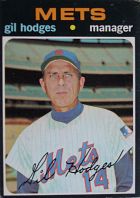
Gil Hodges as manager of New York MetsToday we honor #14, the great Gil Hodges.
Number fourteen. Huh, it just so happens that 14 is the Mets’ magic number.

Anyway …

Some argue that Gil Hodges deserves to be in the Hall of Fame, based on the fact that he led the National League in RBI for the decade of the 1950s. However, his career numbers aren’t quite gaudy enough when compared to the greats of the game — 370 HRs, 1274 RBI, and a .273 average. And though he had some outstanding years with the Dodgers, he never won a homerun title, batting title, nor MVP — partially because of his teammate Duke Snider and partially because his contemporaries included Willie Mays, Stan Musial, Ernie Banks, and Eddie Mathews, among others. Hard to be a star outshining those guys.

Still, Hodges was a solid, steady, and intelligent ballplayer, beginning his career as a catcher before moving to first base — because Brooklyn’s catcher was Roy Campanella). He was a natural at the position, and his defense was revered — evidenced by his 3 Gold Gloves. One of his standard techniques is the first baseman’s “trick” of pulling the foot off the bag a millisecond before the infielder’s throw is caught. Oldtimers will tell you he fooled umpires all the time on close plays with that sleight of foot.

Perhaps more significant was the remarkable popularity of the gentle giant. The rabid baseball fans in Brooklyn revered him above all save perhaps their beloved Duke Snider. Talk to a Brooklynite who grew up in the 1950s and he may tell you that the priests and nuns of the city instructed children to pray for Gil Hodges.

By the time he returned to New York as an original Met, his skills were greatly diminished. He was a shell of his former self, but still heady and a team-first player (think: Shawn Green). He hit the first homerun by a New York Mets player on April 11, 1962, but only hit 7 more before being dealt to the Washington Senators for Jimmy Piersall (who hit his 100th career homer as a Met, and to celebrate, ran the bases backward). With the Senators, he immediately became their manager, and held the helm until 1967. Ironically, though no longer a player, Hodges was traded back to the Mets for Bill Denehy to take over as skipper in 1968. The rest is history — after a typical 9th-place finish in 1968, Hodges guided the Mets to a World Series Championship in 1969 (as well as third-place finishes in 1970 and 1971).

His number 14 was retired by the Mets in 1972, soon after he died at the age of 48 of a heart attack (he was playing golf during off hours of spring training).

Above and beyond his contributions as a baseball player, Gil Hodges served our country during World War II in the United States Marine Corps. He battled in Tinian and Okinawa, earning a Bronze Star and attaining the rank of sergeant. Though he hasn’t yet made it into Baseball’s Hall of Fame in Cooperstown, he was enshrined into the USMC’s Sports Hall of Fame — the induction was celebrated last Friday at Shea (September 7th).

Often, a man’s life on this planet is measured by how he is remembered. If dedications to Gil Hodges are any indication of his greatness, consider this:

… and that’s just a few of the dedications to Hodges in Brooklyn, much less the rest of the US. Not bad for the son of a coal miner from Princeton, Indiana, eh?

Once again … number 14 … hopefully tomorrow we can honor Edgardo Alfonzo or Ron Darling !

Posted in News Notes Rumors | Comments Off on Remembering Gil Hodges

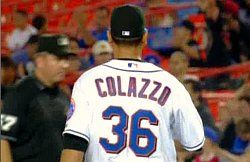
Collazo or Colazzo?

Willie Collazo's name misspelled on Mets uniform

Oops!

Did anyone else catch this?

If you know that Willie Collazo’s name was misspelled on his uniform, then you qualify as a legitimate rabid Mets fan. This photo was taken during his MLB debut … I believe it’s since been fixed.

Posted in News Notes Rumors | 1 Comment

Mets Game 143: Win Over Braves

Mets' David Wright blasts a Tim Hudson pitch into the bleachers for a two-run homerun

Mets 3 Braves 2

It was a classic pitchers’ duel between Oliver Perez and Tim Hudson.

Hudson made few mistakes, but Perez made a few less.

Ollie went 7 full innings, allowing two runs on five hits and two walks, striking out 7. He was focused, pitched with a consistent arm angle, and was on top of his game. It was one of his most impressive performances of the season.

The Mets could muster only one measly run against Hudson through the first five — the lone run scored by Jose Reyes in the initial inning on a groundout by Carlos Beltran. Hudson was rolling ground balls like it was his job, as the Mets killed worms for five innings. Then in the sixth, Reyes led off with a walk, and was sacrificed to second on a great bunt by Luis Castillo, bringing up David Wright. Wright worked the count to 2-2, then went down and drove a flat sidearm slider into the leftfield bleachers for his 28th homer of the season, making the score 3-0.

Perez began the following inning — the seventh — with two quick outs sandwiching a single by Jeff Francoeur. He then went to a full count to Brian McCann before uncorking one of his few mistakes of the evening — a waist-high fastball that got a bit too much of the plate. McCann jumped all over it, blasting it over the rightfield fence to make the score 3-2. Ollie kept his cool and rebounded by striking out Willie Harris, whose body language clearly screamed that he wanted no part of facing Perez at that time.

Aaron Heilman came on to pitch a perfect eighth, bridging the gap to Billy Wagner, who pitched a 1-2-3 inning capped by a sliding catch web gem in the gap by Beltran to end the game.

Notes

A turning point in the game came in the sixth, when the Braves got men on first and second with none out and Edgar Renteria at the plate. Renteria lined out to Wright, then Perez picked off Hudson straying too far from second to squash the threat (a perfect timing play between Ollie and Luis Castillo), and Perez proceeded to strike out Matt Diaz looking to end the inning.

Castillo is really hobbling around on that bad knee, but is somehow gritting through it and both making plays and running the bases well. It’s kind of scary — if his knee were healthy, I think he’d be getting to a few more balls, stealing more bases, and hitting at least 15-20 points higher. And yet he’s still been remarkably effective on the bad wheel.

Reyes finally drew a walk — his first in 37 at-bats — and added a hit and his 75th stolen base. He still looks like he’s jumping a bit at the ball, and making his decision to swing too early, but on several pitches he stayed back the way he should, letting the ball get deep. I’d be fine with him slowly getting his stroke back, then exploding in, say, October.

David Wright is hitting like a man possessed. Those MVP chants at Shea may well become reality. Interestingly, the Mets have never had a Most Valuable Player in their history.

Tim Hudson has to be suffering from some kind of shoulder ailment — or at the minimum, fatigue. He was dropping down sidearm far more often than normal, and moving his arm around in gingerly motions. He’s a pretty tough competitor, so it wouldn’t be a surprise that he’s pitching hurt — and it might explain his last few starts, which have been less than stellar.

SNY finally turned down the orange tint a bit. In their postgame show, both Matt Yalloff and Lee Mazzilli looked nearly human.


Next Game

The Mets and Braves do it again at 7:10 PM. Orlando Hernandez is scheduled to start against Buddy Carlyle — we’ll see if El Duque is good enough to go.

Posted in Mets 2007 Games | 13 Comments

Mets Math

Mets magic number is 15The Mets’ “magic number” is currently 15, going into this three-game set with the Braves. What that means is, any combination of 15 Mets’ victories and the second-place team’s (currently the Phillies) defeats, eliminates the second-place team and makes the Mets NL East Champions.

For example, if the Mets win 8 more games between now and the end of the season, and the Phillies lose 7, the Mets finish in first.

In the recent “series preview” vs. the Braves, I stated that I’d be happy with one win in the Braves series, and one win in the Phillies series. Let me explain why.

With the magic number 15, and 20 games to play, time is running out quickly for the Phillies. If the Mets win just one against Atlanta, and just one this weekend vs. the Phils, the magic number goes down to at least 13. I’m banking on the idea that the Phillies lose at least one of their four games against the Rockies, so that knocks it down to 12, with 14 to play.

Of the Mets’ final 14 games, 13 are against the last-place Marlins and the may-as-well-be-in-last place Nationals (the other game is a makeup vs. the Cardinals). I’m fairly certain the Mets will win at least 7 of those 13, and that knocks the magic number down to 5.

Meantime, the Phillies will have 13 games left: 3 vs. the Cardinals, 7 vs. the Nationals, and 3 against the Braves. While it’s certainly possible that they’ll finish 9-4, I simply don’t see it happening. They would have to win both series against the Cards (in St. Louis) and Braves, and take 5 of the 7 from the Nats (of course, there are other combinations, but I’m throwing that out there as an example, to offer perspective). Again, anything’s possible, but with the Phillies throwing the likes of Adam Eaton, J.D. Durbin, and a fast-fading Jamie Moyer to the mound, that kind of dominance seems like a pipe dream — particularly when their bullpen ERA is around five.

Although the Phillies looked like an unstoppable juggernaut in their four-game sweep of the Mets at the end of August, they haven’t approached that kind of performance since. They’ve gone 4-5 since then, with the same squad. It’s as if they got “up” for that series with the Mets, and the rest has been a letdown. Are they a dangerous team in a very short series? Absolutely, particularly in Citizens Bank Park. Over a stretch of two weeks though, and away from home, the Phillies tend to revert to the mean — an above-average club, but not quite first-place finishers. And 7 of those last 13 games are on the road.

The way the numbers look right now, the Phillies do still have a chance — but they’ll need to get red-hot right now, and they’ll need the Mets to stop their current roll.

Personally, I’m still nervous. However, if the Mets can win both of these next two series, against the Braves and Phillies, I’ll be feeling a whole lot better.

Posted in News Notes Rumors | Comments Off on Mets Math

Series Preview: Mets vs. Braves Finito

Old Atlanta Braves baseball logoIf you told me at the beginning of the season that this final series with the Braves would be arriving a week after the Mets swept the Braves in Atlanta, and up 8 1/2 games over our perennial nemesis, I might not have believed you.

Had you told me this would be the situation after the Braves acquired Mark Teixeira and Octavio Dotel without affecting their starting lineup, I’d think you were playing me the fool.

But here we are, in mid-September, and the Mets are indeed a mile ahead of Atlanta. The Braves’ bullpen is a disaster, they still haven’t found a fifth starter, and Larry Jones is crying about the strike zone. Boo hoo.

It would be nice to see the Mets continue rolling through the Braves, and have momentum for the phinal Phillies series that starts at the end of the week. But it won’t be easy.

The Braves are sending their two aces to the mound — Tim Hudson and John Smoltz — in the games sandwiching a start by Buddy Carlyle, who beat the Mets a month ago. Meantime, the Mets have Ollie Perez and John Maine starting the first and final games against the aces — and both youngsters have been somewhere between adequate and awful in the second half. Let’s take a look at how the series shapes up, game by game.

Game 1: Oliver Perez vs. Tim Hudson

The Mets have won four of Ollie’s last five starts, but that’s been in spite of Perez rather than because of him. He did mix in a beauty — seven innings of shutout ball against the Dodgers on August 24th — but otherwise he has had tremendous struggles, particularly after the first inning of the game. The two most noticeable differences in Ollie’s second half (compared to the first) are 1.) his refusal — or inability — to keep his mechanics and arm angle consistent and 2.) an inability to keep his composure and focus when bad things happen. The first issue can be fixed by Rick Peterson and perhaps a swift kick in the kiester. The second is something he’s struggled with on and off throughout his career, and is tied to his confidence level. When Perez is rolling, he’s nearly unhittable. However, if a broken-bat hit follows an error, he feels the world falling down on him.

Which Ollie will show up on Monday? Who knows, but with Hudson on the hill for the Braves, it would be nice if the “good” Perez would appear.

Hudson, who can look like Sandy Koufax for stretches, is the pitching version of a streaky player. Currently, he’s on a cold streak, having given up 14 earned runs in his last three starts — two of which lasted only five innings. The Mets roped him for four runs on six hits and two homers on the last day of August, and he was pilfered by the Phillies for five runs on 11 hits in five innings five days ago. I’d like to see Marlon Anderson get a start in rightfield against him, as he’s hitting .385 against him — and of the other two outfielders, Moises Alou is batting .429 against Hudson and Carlos Beltran has rapped him at a .354 clip.

Game 2: Orlando Hernandez vs. Buddy Carlyle

Normally we’d look at this game and say this is the “gimme” — the one the Mets should win hands-down. But we thought that the last time Carlyle faced the Mets, since he had a .500 record and Braves killer Ollie Perez on the mound against him. As it turned out, Caryle allowed only three runs, the Braves bullpen held the Mets hitless, and Perez had a 6-run meltdown.

More importantly than a win in this game is the health of El Duque, who left his last game in Philadelphia after three terrible innings with a sore right foot and skipped a start. He had a cortisone shot on September 1st and may or may not be able to start on Tuesday. Is it so important for him to make the start? Might they consider resting him another day and moving Maine up (it’s Maine’s day to pitch anyway)? Maybe they’ll skip him altogether, and give him another shot against the Phils — or maybe that’s exactly what they don’t want, after the drubbing he received at CBP. Time will tell.

Game 3: John Maine vs. John Smoltz

The smell of this matchup is bordering on rancid. Smoltz — forever a thorn in the Mets’ side — has pitched well against the Mets this year, sporting a 2-1 record and 3.66 ERA in five starts. However, the Mets have hit him to the tune of .316, as his slider seems to flatten in the face of the orange and blue. Still, he’s John Smoltz, and he’s therefore going to be tough for 6-7 innings.

Against him is John Maine, whose ERA since August 1 is an even 7.00 — and he’s facing the third-best offense in the NL (the two above them are the Phils and Rockies, who benefit from hitters’ parks). Not to mention his 5.11 ERA against the Bravos this season. His last start was his worst of the season, as he couldn’t get out of the fifth inning. Maybe the extra day of rest will help him somehow. Maybe this is the start where he begins to reverse the trend, and begin pitching well again — a nice finish and good roll going into the postseason. Or perhaps this is another bad game, and we’ll have to wonder if he’ll ever find his way back.

Bottom Line

A sweep is not necessary, and neither is winning the series. In fact, in these last two series against the Braves and Phillies, all I’m hoping for is one win in each. The Phillies play the Rockies for a four-game set beginning today, and I doubt very highly they’ll sweep them. That said, if the Mets can take one of these next three, then one against the Phillies over the weekend, neither team will gain appreciable ground with two weeks left in the season — and the Mets play 13 of their last 14 games against the Marlins and Nationals. Suffice to say, I might start to feel a little confident if the Mets are up by at least 5 with 14 to play — though I’ll still be guarding against a colossal collapse.

Almost as important as seeing wins, we need to see the following:

  1. Jose Reyes to start hitting
  2. Orlando Hernandez healthy
  3. Oliver Perez to pitch with consistent mechanics again
  4. John Maine pitch like we know he can

If we can see all of the above, and squeak out at least one win, the series — in my eyes — is a success.

Posted in Series Previews | Comments Off on Series Preview: Mets vs. Braves Finito